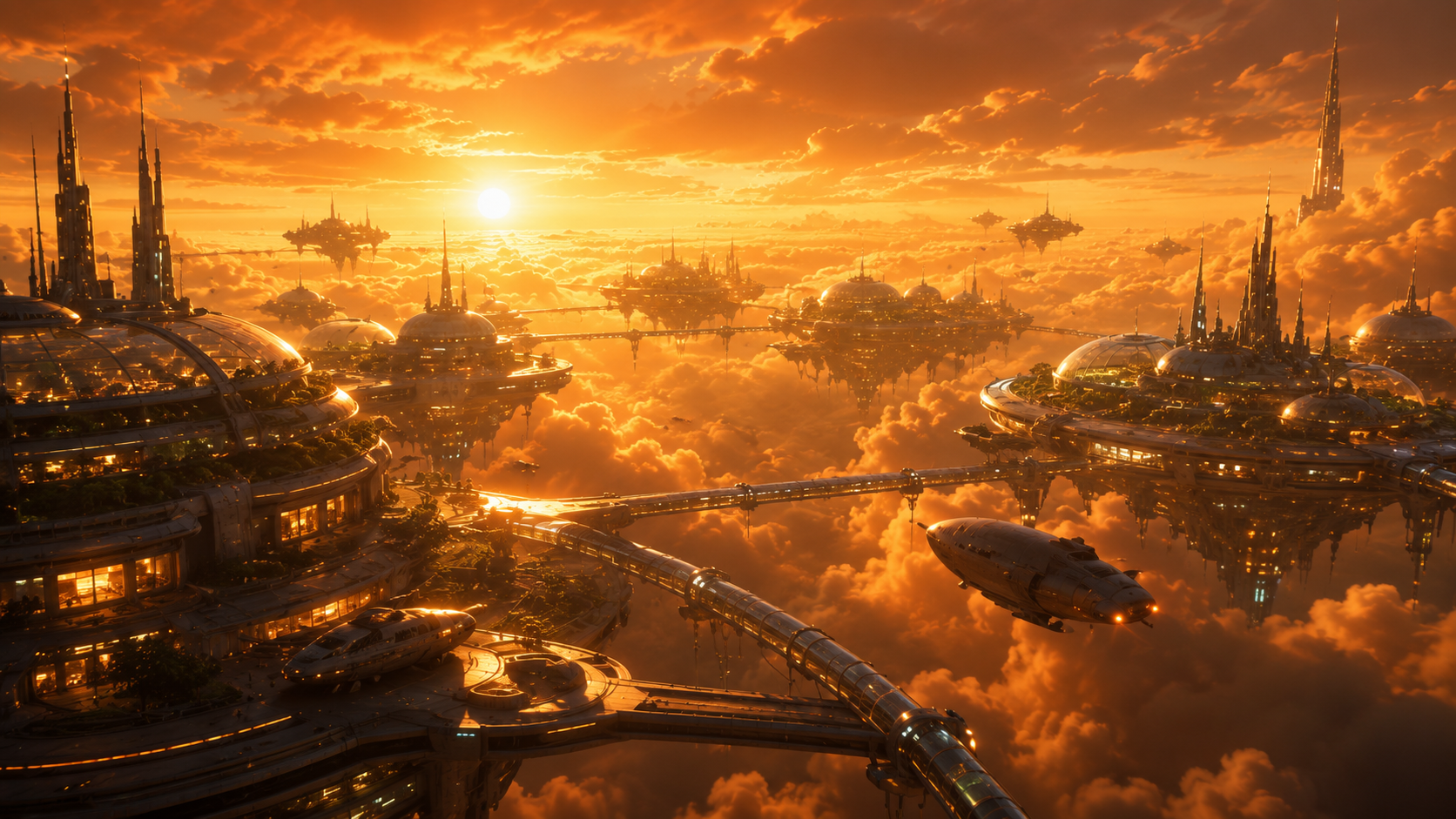
Comparing the planets means comparing habitats
A fair Venus-versus-Mars discussion starts by distinguishing the surface of Venus from its temperate cloud layer. Venus's ground is roughly 467°C (872°F), with pressure about 93 times Earth's sea-level pressure. Building an exposed settlement there would be extraordinarily challenging. Around 50 kilometers up, conditions are very different, which motivates the idea of floating habitats.
Mars offers a solid surface to land on and build upon, but its atmosphere is extremely thin, its temperatures are generally cold, and its natural radiation shielding is limited. No known site on either planet allows people to walk outside without serious protective systems.
Gravity: Venus has an advantage
Venus has about 91% of Earth's surface gravity. Mars has about 38%. The long-term biological effects of living in low gravity remain uncertain, so Venus's near-Earth gravity is an intriguing advantage. However, floating architecture must still be engineered to support people, water, and equipment.
Atmospheres: very different tradeoffs
Mars's thin atmosphere offers little pressure, so pressurized habitats are mandatory, but its relative transparency can help direct surface observation. On Venus, a cloud habitat might encounter near-Earth pressure outside, reducing certain structural pressure differences. Yet it would be surrounded by mostly carbon dioxide and corrosive cloud droplets. The presence of pressure does not provide oxygen or drinking water.
Venus also lacks an Earth-like global magnetic field, and Mars lacks a strong global magnetic field as well. Radiation protection depends on actual altitude, atmospheric shielding, solar events, and habitat construction—not simply which planet is closer to the Sun.
Resources and transport
Mars offers surface ice and rock that explorers could potentially use for water, construction, and manufacturing. A Venus cloud habitat would have access to atmospheric gases but face a difficult supply chain for water, metals, heavy equipment, and replacement parts. On the other hand, a floating Venus base could avoid some of the problems posed by Martian dust and low atmospheric density.
Landing a spacecraft on Mars is difficult because its thin air provides too little braking for many payloads. Reaching a Venus cloud habitat presents a different challenge: high-speed entry, aerial rendezvous, and eventually launching back out of the gravity well.
Which planet wins?
If the goal is a near-term human outpost on solid ground, Mars has a more mature body of surface exploration experience. If the goal is investigating long-term aerial habitats under nearly Earth-like gravity, Venus is an unusually compelling research target. Neither is remotely ready for ordinary, self-sufficient human settlement.
The most productive next step is not to declare a winner but to test the technologies each environment needs.
Sources & further reading
Primary references supporting the scientific background of this article.